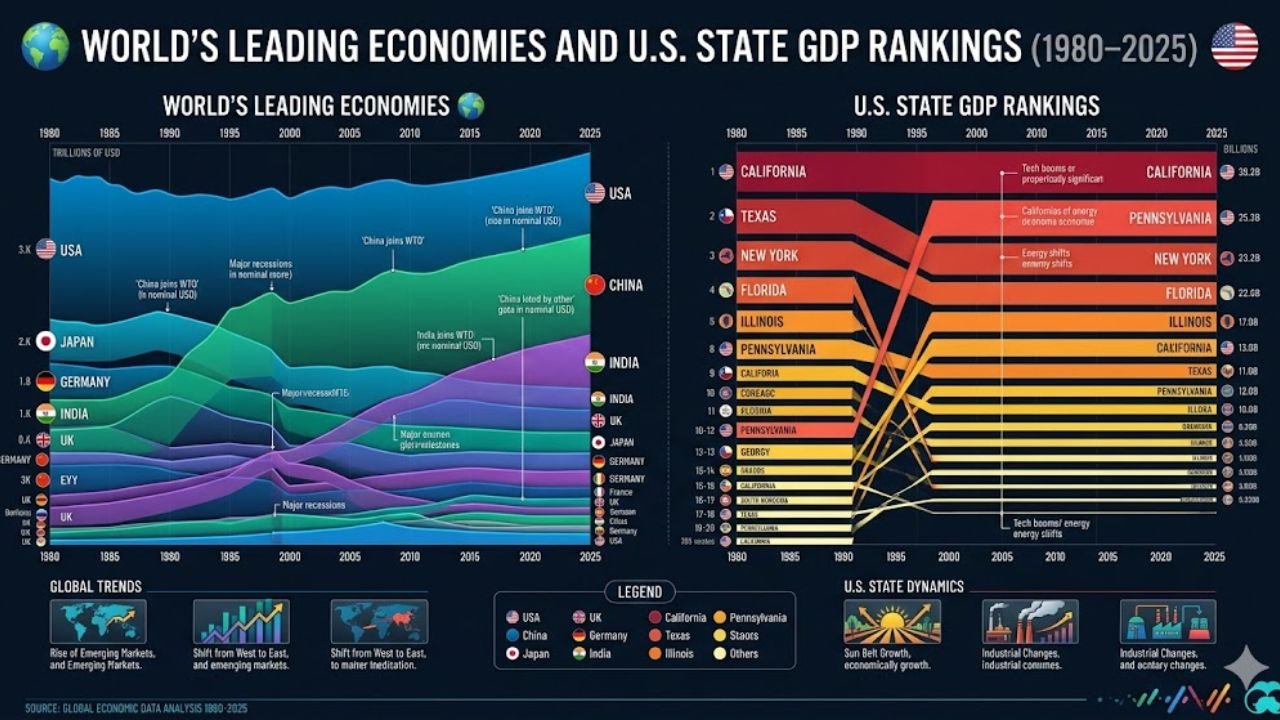
In the past 45 years, the world’s leading economies have fundamentally changed. In 1980, the United States and the Soviet Union dominated the world economies along with Western Europe and Japan, while China and India were hardly developing economies. Now, while the United States is still the largest economy, China has surpassed the others and is competing against Germany, Japan, India, and others. The difference between 1980 and the predicted 2025 shows the impact of demographics, technology, policy, and globalization.
Top Economies in 1980
In 1980, the United States had the leading economy with a nominal GDP of roughly 2.8 trillion dollars, followed by the Soviet Union, Japan, and West Germany. During this time, China was still not a major player nominally and India was below the global top tier. The top ten list was a story of Western economies and the Soviet Union, reflecting the early stages of industrialization and globalization.
Top Economies in 2025
In 2025, things look different again. The US still ranks first, with nominal GDP standing at roughly 30 trillion dollars, but China has jumped to second place with an economy of more than 19 trillion dollars. In the next tier, with multi-trillion-dollar output, are Germany, Japan, and India. The top ten are rounded up by the United Kingdom, France, Italy, Brazil, and Canada. This change showcases two major trends:
- The rise of Asia as a center for manufacturing and services.
- The established Western economies, which show resiliency as they keep high income levels, even when their portions of global GDP have decreased.
A Look At Top Economies (Nominal GDP, 2025, based on IMF data)
| Rank | Country | Estimated GDP 2025 (USD) |
|---|---|---|
| 1 | USA | 30.6 trillion |
| 2 | China | 19.4 trillion |
| 3 | Germany | 5.0 trillion |
| 4 | Japan | 4.3 trillion |
| 5 | India | 4.1 trillion |
Inside the United States: State Economies as Global Players
U.S. states are starting to compete with entire countries in terms of economic scale. California, for instance, has a state GDP of about $4.1 trillion, which would make it one of the largest economies in the world as a separate country. It is powered by technology, entertainment, and advanced manufacturing, along with high-value services, as Silicon Valley and Hollywood are global centers for innovation and culture.
Another state that stands out is Texas, with a GDP of over $2.7 trillion, primarily driven by energy and manufacturing, and a rapidly growing population. New York’s economy, nearly $2.3 trillion, is bolstered by finance, media, and professional services centered in New York City. Florida’s GDP is between $1.7 trillion and $1.8 trillion, reflecting growth in tourism, logistics, and services.
These four states alone are equal to or greater than many G20 economies. This shows how the economic power of a country is concentrated in a few large, diversified areas. States like California and Texas also serve as testing grounds for new policies, from climate and taxes to infrastructure, which can influence broader national strategies.
Drivers of Change: Demographics, Technology, and Policy
Economic shifts and GDP rankings from 1980 to 2025 are driven by structural forces. Demographics are central: younger, growing populations, like those in India, create expanding labor forces and domestic markets. In contrast, advanced economies in Europe and East Asia rely on productivity improvements and innovation to sustain output due to slower population growth.
Technological change is another key factor. The digital revolution, automation, and improved communication have allowed countries to adopt advanced industrial models quickly, bypassing traditional development stages. China’s manufacturing and export-led growth and the U.S.’s leadership in software, artificial intelligence, and high-end services illustrate this trend.
Policy decisions also shape outcomes. Economies integrated with global markets and offering stable macroeconomic policies attract investment, while underinvestment and political instability can lead to stagnation. Environmental and energy policies increasingly influence capital flows, industry adaptability, and long-term economic sustainability.
Why People and Policies Should Consider GDP Rankings
GDP rankings matter beyond prestige. Policymakers, investors, and citizens benefit from understanding them. Large economies gain international negotiating power, defense and social funding, and the ability to attract investment and migration. They can set regulatory frameworks and trade standards, while smaller economies adapt to these rules.
However, GDP alone does not reflect income distribution, quality of life, or environmental conditions. Economic growth may not be equally experienced. California and India, for instance, have large economies, but citizens’ experiences differ. Understanding these trends helps students, workers, and entrepreneurs plan careers, establish businesses, and influence policies for diversified and sustainable development.
FAQs
Q1 Which country will have the largest economy in 2025?
Based on nominal GDP, the United States will continue to be the largest economy.
Q2 Which state has the largest economy in the US?
California is the state with the largest economy in the US, comparable to a major G20 country.
Q3 What caused China to experience rapid growth in GDP?
China’s rapid economic growth is the result of decades of industrialization, export-led development, and integration into global supply chains.