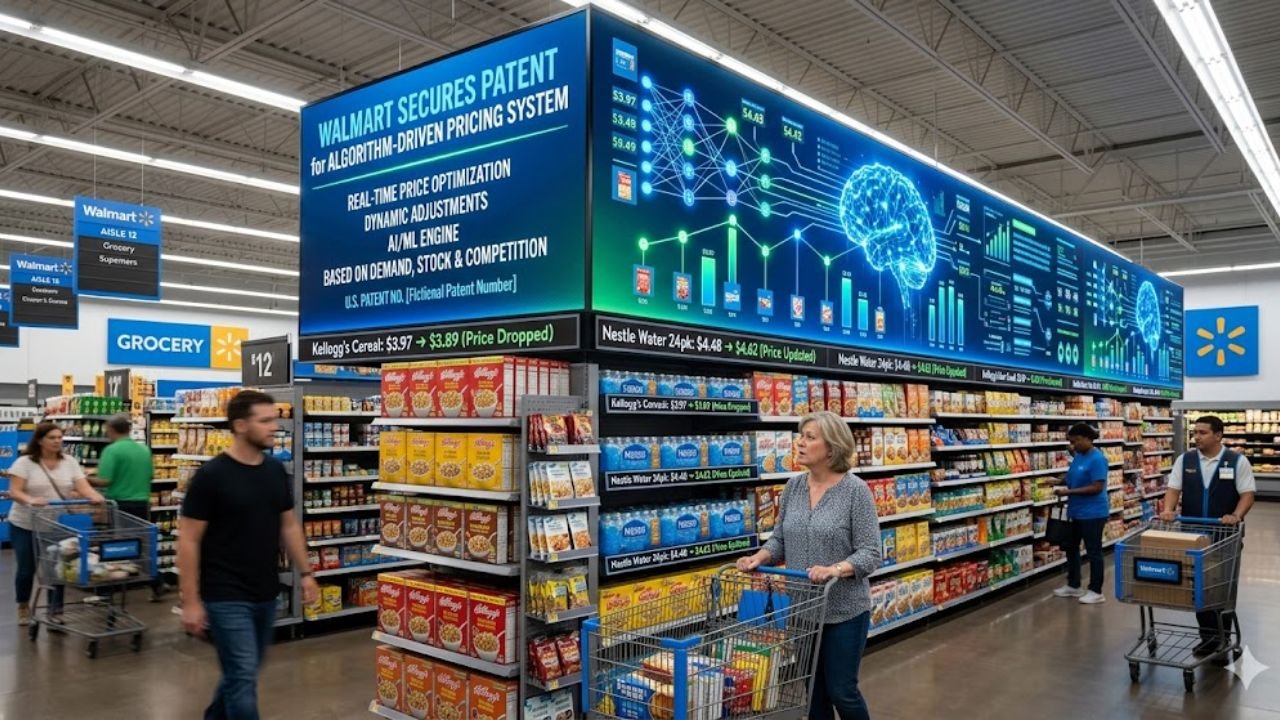
Walmart has long been a leader in retail logistics, but the company is now moving into a new era of hyper-intelligent commerce. A recently awarded patent outlines an advanced algorithmic pricing system integrated with Electronic Shelf Labels (ESLs) across its stores. This is not just a simple digital price tag—it is a smart system powered by machine learning that adjusts prices based on consumer demand, local inventory, purchasing patterns, competitor pricing, and internal operations. The goal is to automate pricing updates while maintaining strong price leadership in the retail market.
The Technology Powering the Digital Shelf
The patented system uses machine learning to determine optimal pricing for more than 120,000 products. It operates through a “digital shelf fabric,” a network connecting multiple stores that allows prices to be updated within seconds. Traditionally, store associates could spend hours—or even days—manually updating price tags. This new system eliminates that inefficiency, freeing employees to focus on customer service and inventory management.
Another key feature is the “Stock to Light” function. LED indicators built into shelf labels guide employees directly to items that need restocking. This improves operational efficiency and ensures shelves remain well-stocked, reducing frustration for customers.
Advanced Inventory and Lifecycle Pricing
The system also integrates with Walmart’s advanced inventory management tools. One of the standout innovations is “lifecycle pricing,” which allows the retailer to adjust prices based on a product’s stage in its lifecycle. For example, new items can be introduced at competitive prices, while perishable goods approaching expiration can be heavily discounted.
This approach not only strengthens Walmart’s competitive positioning but also helps tackle food waste—an ongoing issue in the retail industry. By dynamically adjusting prices, the company can move products more efficiently and reduce the volume of unsold goods.
Concerns Around Real-Time Pricing
Despite its benefits, the introduction of “real-time surge pricing” has raised concerns among consumers and lawmakers. Many worry about the possibility of fluctuating prices for essential goods such as milk, eggs, and other daily necessities.
Walmart has addressed these concerns by stating that its pricing technology is designed to support its Everyday Low Price (EDLP) strategy, not to enable predatory pricing practices. The company has clarified that price updates are scheduled during less busy hours to ensure consistency between shelf prices and checkout totals.
Transparency and Consumer Trust
As autonomous AI becomes more integrated into retail operations, transparency will be essential. Walmart has emphasized that maintaining customer trust is a priority, especially as it introduces new technologies that directly impact the shopping experience.
The company also reassures customers that Electronic Shelf Labels do not track personal activity. These devices operate within a closed system and are designed solely to display pricing and product information. They do not include cameras, microphones, or tracking capabilities.
The Future of the Retail Experience
The patent also points toward future innovations such as augmented reality (AR) and peer-to-peer (P2P) virtual mapping. With real-time pricing and indoor geolocation, shoppers could receive instant alerts for discounts or promotions as they move through store aisles. For example, a customer might get a notification about a “flash rollback” on a previously purchased item when walking near it.
This integration of digital intelligence with physical retail spaces represents the long-awaited “omnichannel” experience—blending online data with in-store shopping in a seamless way.
With plans to roll out this technology in more than 2,300 stores, Walmart is setting the stage for a major shift in how retail operates. The combination of automation, data intelligence, and real-time responsiveness could redefine the in-store experience for both customers and employees.
FAQ
Q1 Will Walmart use this system for surge pricing during peak hours?
No. Walmart has stated that Electronic Shelf Labels will not be used for dynamic surge pricing. Price changes are scheduled during non-peak hours to ensure consistency for shoppers.
Q2 Do these electronic shelf labels track customer behavior?
No. The labels operate on a closed system and are designed only to display pricing and product details. They do not include tracking features such as cameras or microphones.
Q3 How does this benefit consumers?
This technology improves pricing accuracy, reduces checkout discrepancies, and ensures better product availability. With faster restocking and fewer pricing errors, customers can enjoy a smoother and more reliable shopping experience.