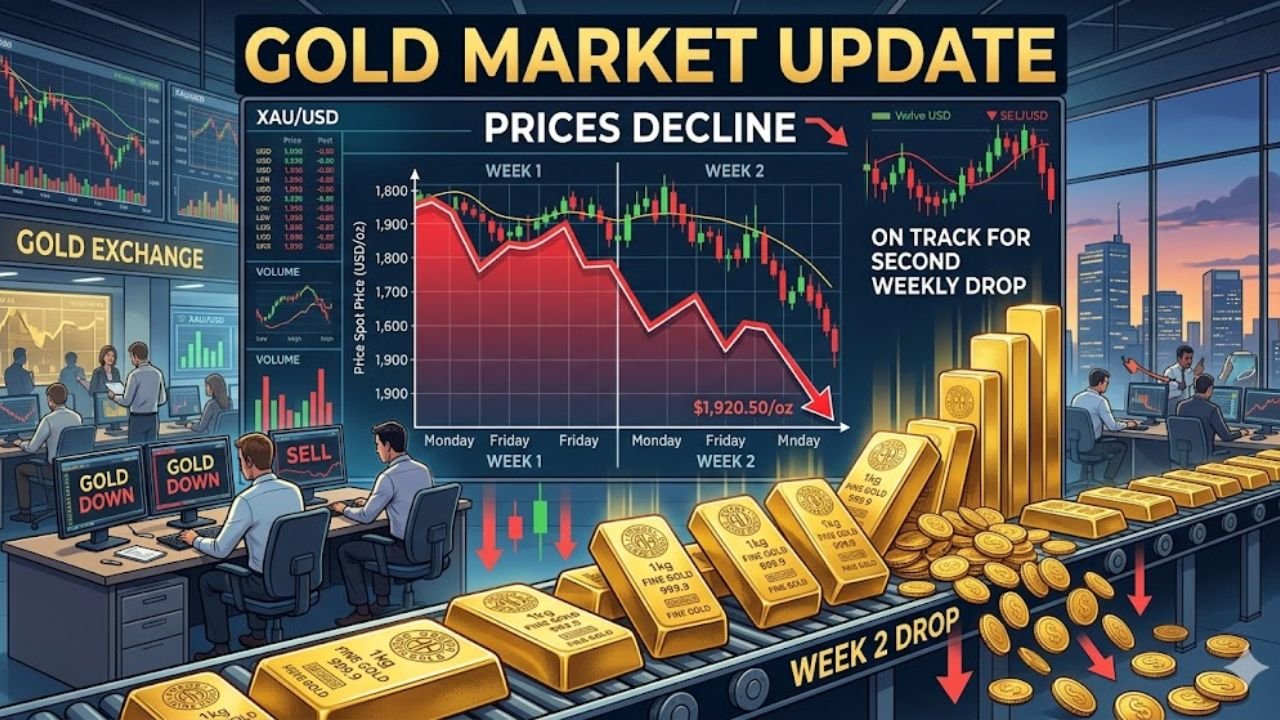
The strain on the global gold market has become evident as spot prices drop from the record-high levels reached earlier this year. As of March 2026, gold prices have declined to around $5,030 per ounce, and forecasts indicate the metal could fall for the second consecutive week. While such a decline might appear surprising given the geopolitical unrest in the Middle East and the closure of the Strait of Hormuz, several market experts had anticipated the correction.
Historically, periods of geopolitical tension push investors toward safe-haven assets like gold. However, the current market environment is being driven by a combination of a stronger U.S. dollar, rising Treasury yields, and changing expectations around interest rate cuts.
Primary Factors Behind the Pressure on Gold Prices
The main factor behind the recent sell-off is the strengthening U.S. dollar and the sharp increase in bond yields. At the same time, oil prices have surged above $100 per barrel, shifting investor focus toward energy markets.
This surge in oil prices has led many institutional investors to believe the Federal Reserve may delay interest rate cuts until 2026 or even 2027. Higher interest rates increase the opportunity cost of holding non-yielding assets like gold. As a result, gold becomes less attractive compared with interest-bearing investments such as bonds and savings instruments.
Another factor influencing prices is the liquidation in the “paper gold” market. Futures contracts and gold ETFs are witnessing significant selling as traders face margin calls and raise cash to manage volatility in other financial markets.
Current Gold Market Data and Regional Pricing
The first quarter of 2026 provides a clear picture of the current gold market performance across global regions. Despite short-term price fluctuations, gold continues to show strong annual gains.
| Pricing | Current Price (USD) | Weekly Change | Annual Performance |
|---|---|---|---|
| Gold Spot Price (Per Oz) | $5,032.82 | -2.97% | +67.24% |
| Gold Price (Per Gram) | $161.81 | -1.10% | +68.30% |
| 24K Gold (India – 10g) | $1,58,622 | -1.05% | +34.50% |
| Silver Spot Price (Per Oz) | $80.54 | -3.92% | +138.47% |
Institutional and Central Bank Demand Remains Strong
Despite the recent correction, the long-term demand for gold remains strong. Central banks, particularly in emerging economies, continue to diversify their reserves away from traditional fiat currencies.
China has reportedly been purchasing gold continuously for more than 16 months. These purchases are part of a strategy to hedge against trade sanctions and reduce reliance on foreign currencies. Such central bank accumulation is often seen as a structural support for gold prices in the long term.
Many analysts also believe the current downturn is a healthy “shakeout” of leveraged positions in the market. By clearing excessive speculative bets, the market could reset for a potential upward move toward the $6,000 level, a target projected by several major investment banks for late 2026.
Future Outlook for Precious Metals
The precious metals market is increasingly influenced by real-time information flows and algorithm-driven trading systems. As financial news spreads quickly across digital platforms, market sentiment can change rapidly.
Financial planners typically recommend a long-term strategy rather than attempting to predict a single market bottom. Although the Federal Reserve’s hawkish stance may create short-term pressure on gold prices, the fundamental reasons for holding gold remain intact.
The gold market will continue to respond to changes in oil prices, the U.S. dollar index, and central bank policies. If high interest rates slow global economic growth, policymakers may eventually shift toward rate cuts, which could once again support gold prices.
For now, analysts believe gold is entering a consolidation phase, with strong support forming near the $5,000 per ounce level while the market waits for clearer macroeconomic signals.
FAQs
Q1 Why are gold prices falling despite tensions in the Middle East?
Although geopolitical conflicts usually boost gold prices, the current situation has increased oil prices and inflation concerns. Higher inflation encourages central banks to maintain elevated interest rates. This strengthens the U.S. dollar and makes interest-bearing assets more attractive than gold.
Q2 What is the expected price floor for gold during this correction?
Many analysts believe there is strong buying interest around the $5,000 per ounce level. This price point acts as both a psychological and technical support zone where central banks and long-term institutional investors may step in to accumulate gold.
Q3 Is this a good time to buy gold?
Market experts often view a 5% to 10% correction during a bull market as a healthy opportunity. Investors may consider a staggered accumulation strategy to average purchase prices while reducing short-term risk exposure.