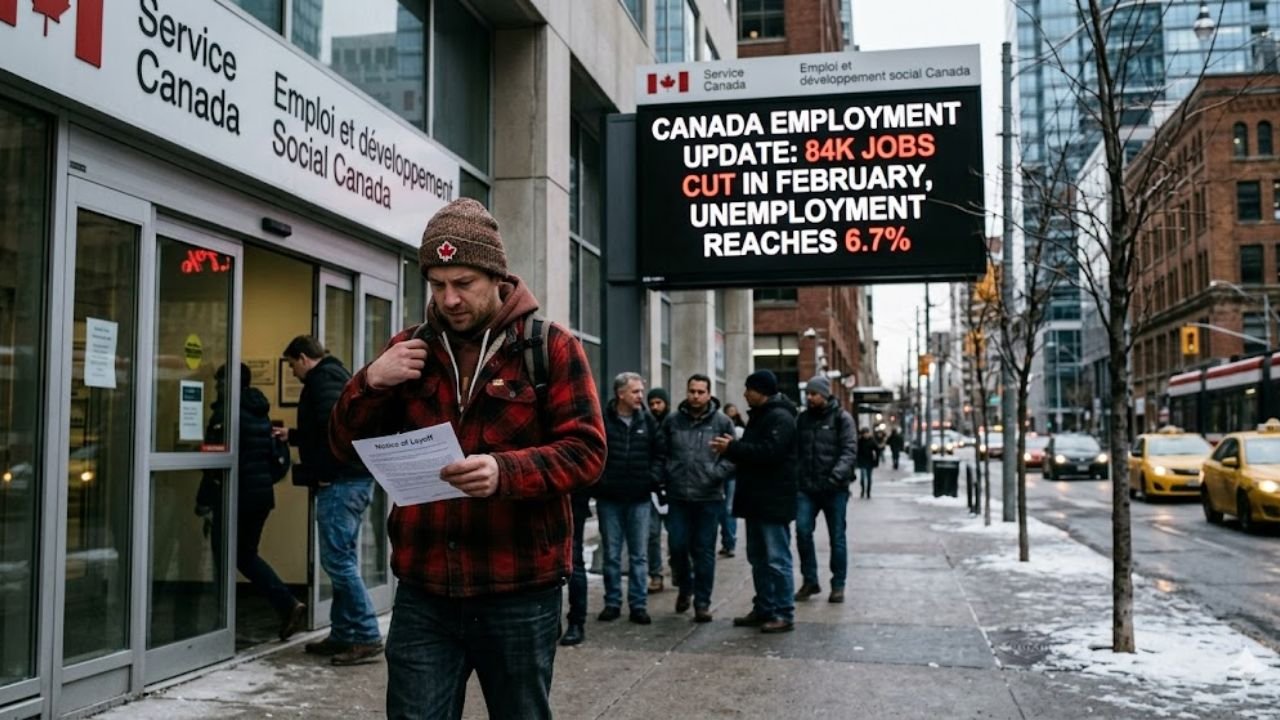
Statistics Canada recently released a new labor force survey that has captured the attention of the national economy. The report shows a significant contraction in Canada’s labor market for February 2026. The country lost 84,000 jobs in a single month, signaling that the central bank’s cooling measures over the past year are beginning to slow the private sector.
This shift contrasts sharply with the strong hiring trend seen in 2025 and suggests that many companies are now focusing on cost-cutting rather than expanding their workforce. Economists say that although some job losses are seasonal, the widespread decline across several industries suggests a deeper and possibly longer-lasting slowdown in demand.
This report is more than just a collection of statistics for Canadian households. It directly impacts how families perceive the economy and how they plan their financial future.
National Unemployment Rate Rises
The unemployment rate increased to 6.7%, raising concerns among policymakers and government officials. Beyond the immediate job losses, the rising rate indicates that the economy currently has a surplus of workers and is struggling to absorb new entrants into the labor market.
This includes recent immigrants and newly graduated students who are seeking employment opportunities. When unemployment rises this quickly, both consumers and businesses tend to become more cautious.
Economic experts say that unemployment levels around 6.7% often increase pressure on the federal government to maintain spending programs. These may include job creation initiatives or financial support for key industries struggling under high borrowing costs.
Provinces like Ontario and British Columbia have been hit hardest in sectors such as technology and manufacturing, where high interest rates have made it expensive to continue funding capital-intensive projects.
Sector Performance and Regional Differences
Although the overall numbers may appear pessimistic, the impact has not been equal across all industries. The service sector, especially hospitality and retail, experienced significant job cuts in February. Much of this decline is linked to reduced discretionary spending as many Canadians face higher mortgage payments.
However, some sectors showed resilience. Healthcare and renewable energy industries managed to maintain stability and even add jobs in some cases, though hiring has slowed compared to previous months.
These conditions highlight the importance of skill development. Job seekers may find better opportunities by focusing on industries that remain stable or continue to grow.
Regional Employment Snapshot – February 2026
Region / Sector
Job Change
Unemployment Rate
Ontario (Manufacturing)
-22,000
7.1%
British Columbia (Tech)
-15,000
6.4%
Quebec (Services)
-18,000
6.2%
Alberta (Energy)
+2,500
5.9%
Atlantic Canada (All Sectors)
-4,000
8.3%
Impact on Consumer Confidence and Spending
Employment stability is one of the main drivers of consumer spending. With 84,000 Canadians losing their jobs, several sectors of the economy—including housing and automotive sales—could experience noticeable slowdowns.
In uncertain economic periods, households often increase savings and reduce discretionary spending. As a result, foot traffic at shopping centers and retail outlets may decline, further affecting business revenues.
Financial experts advise individuals to strengthen their financial safety nets during uncertain times. This includes building emergency savings, improving professional skills, and exploring flexible or remote work opportunities.
Future Outlook for the Canadian Economy
The year 2026 could prove pivotal for Canada’s economic direction. Future policies will depend heavily on global trade conditions, inflation trends, and the central bank’s monetary policy decisions.
If inflation continues to move toward the central bank’s target, interest rate cuts may become possible later in the year. Such a move could stimulate sectors like construction and real estate by the summer.
In the short term, the government is expected to focus on strengthening the country’s social safety net, including expanding Employment Insurance support for the growing number of claimants.
While the current figures present challenges, economists note that economic downturns often lead to periods of stabilization that ultimately create stronger and more sustainable growth.
Canadian workers have faced and overcome economic cycles many times in the past. The current slowdown may represent a period of adjustment rather than a prolonged decline.
FAQs
Q1 What caused the loss of 84,000 jobs in February?
The primary causes include high interest rates that reduced business investment, lower consumer spending in service industries, and a correction in the technology sector following rapid growth in previous years.
Q2 Will the unemployment rate continue to rise?
Most analysts expect unemployment to remain between 6.5% and 7.0% for the next few months before stabilizing, unless there is a significant change in monetary policy.
Q3 Which provinces were most affected?
Ontario and Quebec experienced the largest job losses due to their strong reliance on manufacturing and service industries that are sensitive to interest rate changes.