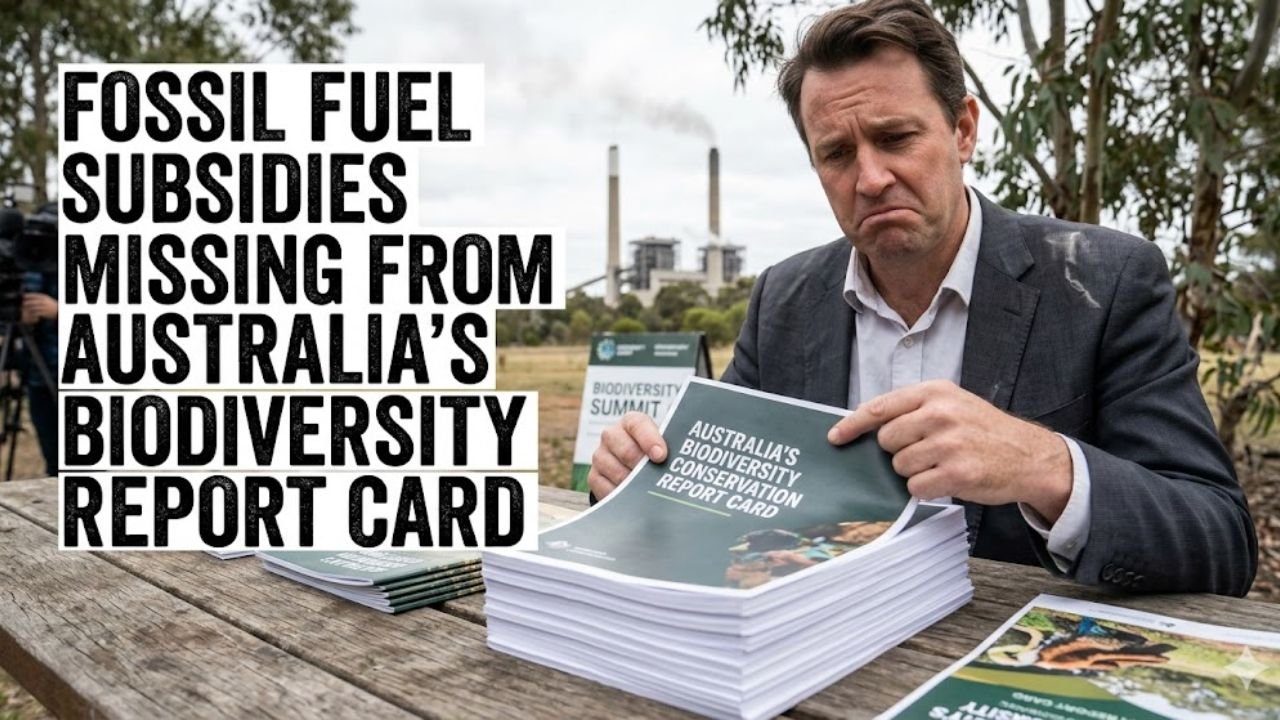
In March 2026, a critical issue has emerged at the intersection of environmental conservation and national fiscal policy. The Australian government released its first progress report under the Kunming-Montreal Global Biodiversity Framework, presenting it as a national “report card” on nature. While the report offers an optimistic outlook on efforts to halt species extinction, scientists and policy experts argue it omits a major factor: fossil fuel subsidies.
An independent analysis by the Australia Institute and the Biodiversity Council highlights that billions of dollars in fossil fuel subsidies were largely excluded from the government’s assessment. These subsidies play a significant role in driving habitat destruction, accelerating climate change, and undermining ecosystem stability. By failing to account for them, the report overlooks a primary contributor to biodiversity loss.
Imbalance Between Nature Protection and Industry Funding
The 2025–26 federal budget reveals a stark imbalance in funding priorities. While hundreds of millions are allocated toward biodiversity protection and restoration, billions continue to support fossil fuel industries. This disparity raises serious concerns about Australia’s environmental commitments.
| Funding Category (2025–26) | Estimated Annual Cost | Primary Impact Area |
|---|---|---|
| Federal Fuel Tax Credit Scheme | $10.8 Billion | Mining and heavy industry diesel use |
| Total Fossil Fuel Subsidies | $16.3 Billion | Carbon emissions and habitat fragmentation |
| Biodiversity & Nature Repair | $1.5 Billion | Threatened species and land restoration |
| Biodiversity-Harming Subsidies | $26.3 Billion | Logging, mining, and land clearing |
Scientific Criticism of Government Claims
Leading ecologists from institutions such as the Australian National University and the University of Queensland have described the government’s self-assessment as “fantastical.” Despite claims that Australia is on track to meet conservation targets, more than 2,200 species are currently classified as threatened.
Critics argue that the government’s methodology prioritizes administrative progress—such as policy frameworks and institutional setups—over measurable ecological outcomes. For example, while 52% of Australia’s marine territory is labeled as protected, much of this area lies in remote deep-sea regions, offering minimal protection to vulnerable ecosystems like seagrass beds and shellfish reefs.
Economic Contradictions in Environmental Policy
The exclusion of fossil fuel subsidies from biodiversity reporting highlights a deeper economic contradiction. While proponents argue that subsidies help manage living costs and protect jobs, data suggests otherwise. Reports indicate that fossil fuel subsidies are increasing rapidly, reaching approximately $31,020 per minute—surpassing funding for major social programs.
This approach creates a “double deficit”: immediate financial losses from subsidies and long-term costs associated with environmental degradation, disaster recovery, and ecosystem restoration.
Need for Environmental Fiscal Reform
Experts argue that Australia has the opportunity to lead globally by aligning fiscal policy with environmental goals. Transparent reporting that includes both “green” (beneficial) and “brown” (harmful) spending is essential for accurate environmental accountability.
Reforming or eliminating fossil fuel subsidies—such as the Fuel Tax Credit Scheme—could free up billions of dollars for biodiversity protection. Redirecting these funds toward genuine conservation efforts would significantly strengthen Australia’s ability to meet its international commitments.
A Path Toward Evidence-Based Environmental Policy
Moving forward, experts emphasize the need for evidence-based reporting rather than self-assessment. Achieving meaningful progress will require coordinated action between the Treasury and the Department of Environment through a whole-of-government approach.
If Australia aims to meet its 2030 biodiversity targets, it must integrate economic policy with environmental responsibility. Addressing the omission of fossil fuel subsidies in official reporting would mark a crucial first step toward genuine sustainability leadership.
FAQs
Q1 What is the Global Biodiversity Framework?
The Global Biodiversity Framework is an international agreement signed by 196 countries, including Australia. It aims to halt and reverse biodiversity loss by 2030 through 23 specific targets.
Q2 Why do fossil fuel subsidies harm biodiversity?
Fossil fuel subsidies lower the cost of activities that contribute to climate change, the leading driver of biodiversity loss. They also encourage land clearing, mining, and industrial expansion in ecologically sensitive areas.
Q3 How does fossil fuel spending compare to nature funding in Australia?
In 2025–26, Australia allocated approximately $16.3 billion to fossil fuel subsidies—more than ten times the funding directed toward biodiversity and nature repair initiatives.