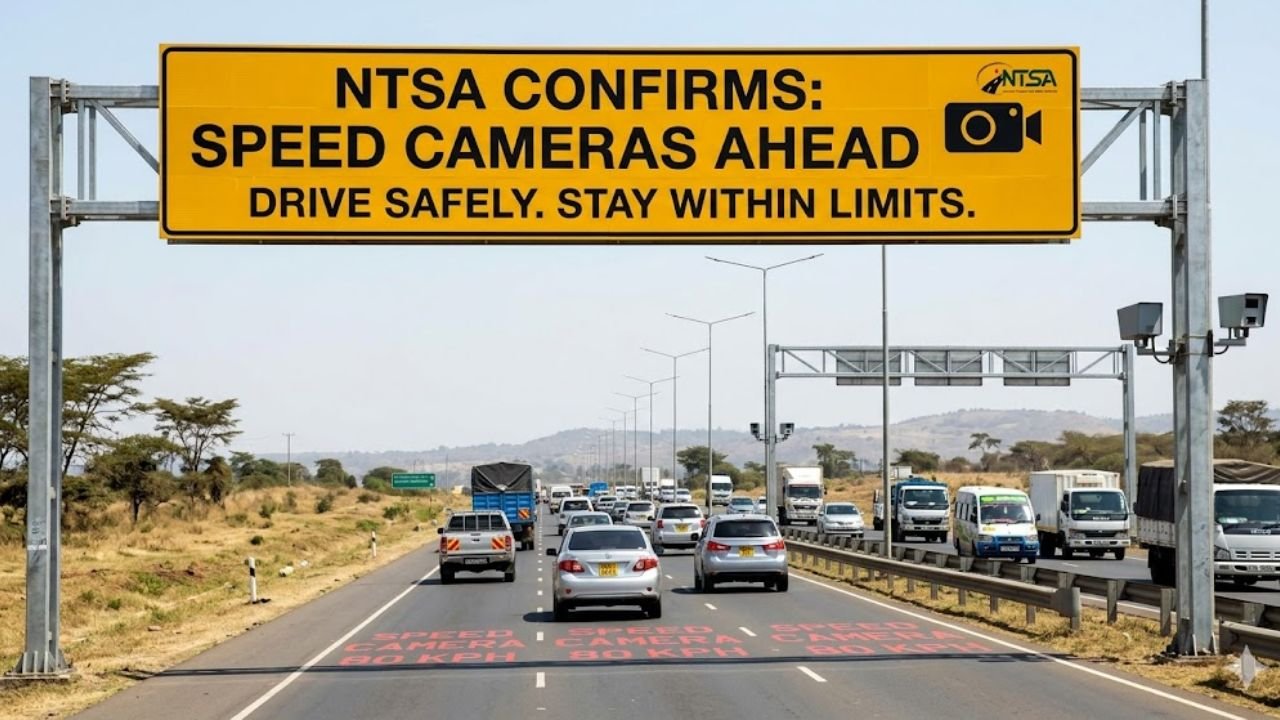
National Transport and Safety Authority (NTSA) has announced a major change in Kenya’s road traffic management system. Beginning in early 2026, all newly installed speed cameras across the country will be clearly marked with standardized signage. The move signals a shift away from so-called “gotcha” policing toward a deterrence-focused traffic enforcement strategy.
The authority says the presence of visible speed cameras will encourage drivers to slow down voluntarily and comply with traffic regulations without necessarily receiving fines. This initiative forms part of a larger 42 billion Kenyan shilling digital road infrastructure program aimed at improving road safety and reducing accidents at known black spots.
NTSA Digital Traffic Management Program
Most of the new NTSA traffic management cameras will be used for traffic control and road surveillance. Installation of the first National Traffic Management System (NTMS) cameras has already started along major road corridors including the Thika Super Highway, Southern Bypass, and Mombasa Road.
As of February 2026, more than 1,000 high-definition cameras are expected to be installed on some of the most heavily traveled roads in Kenya. These devices feature advanced sensors integrated with Automatic Number Plate Recognition (ANPR) technology to capture and monitor traffic violations in real time.
Clear Road Signs for Transparency
To improve transparency, NTSA has introduced a rule requiring reflective road signs to be placed between 200 and 500 meters before every stationary speed camera unit. The signage alerts drivers that they are approaching a monitored zone.
This approach mirrors speed enforcement practices used in countries such as the United Kingdom and Singapore. In those systems, the goal of enforcement is primarily accident prevention rather than revenue collection from fines.
Digital Enforcement and Instant Fine System
The new digital enforcement framework reduces human involvement in roadside traffic policing, which also helps minimize opportunities for corruption or bribery. Under the system, cameras automatically detect vehicles exceeding speed limits and capture images of their license plates.
The information is instantly transmitted to the NTSA database. Once a violation is confirmed, the vehicle owner receives an SMS notification detailing the offence, including the recorded speed, time of violation, and exact location.
Vehicle owners will have seven days to pay the fine. Failure to pay within that period will trigger penalties, and the vehicle’s registration status may be restricted. This means the owner will be unable to access several government services, including vehicle transfers, registration renewals, or certain licensing services until the fine and accumulated interest are settled.
The automated system, sometimes referred to as a “virtual cop,” can enforce traffic rules continuously, unlike human officers who can only monitor roads for limited periods.
Speeding Penalties and Offence Categories
The NTSA has introduced a structured penalty framework designed to clearly communicate the risks and consequences of speeding. Fines increase depending on how much the driver exceeds the speed limit.
Offence Category
Speed Variation
Fine Amount (KES)
Minor Speeding
6–10 km/h over limit
500
Moderate Speeding
11–15 km/h over limit
3,000
High Velocity Speeding
16–20 km/h over limit
10,000
Reckless Speeding
Over 20 km/h above limit
Court Summons
Lane Indiscipline
N/A
5,000
Mobile Phone Usage While Driving
N/A
2,000
Impact on Transport Operators
The new system has received mixed reactions from transport industry groups and motorists. Public transport operators, including matatu drivers and trucking companies, may experience increased operational accountability.
Since the registered vehicle owner is responsible for paying fines, fleet managers will need to closely monitor driver behavior to avoid penalties.
Reducing Road Fatalities
Kenya currently records around 5,000 road deaths annually. The NTSA hopes that visible cameras and warning signs will encourage continuous compliance with traffic rules, making roads safer even when police officers are not physically present.
To build public trust, the authority has also pledged routine calibration and technical checks of all speed detection equipment and AI systems used in the enforcement network.
FAQs
Q1 When will speed cameras be installed in my area?
NTSA states that all fixed speed camera locations will have standardized road signs alerting drivers before they reach the camera zone.
Q2 What should I do if I receive an unfair speeding ticket?
If you believe a ticket was issued incorrectly, you have seven days from the date of issue to review the evidence on the NTSA website. This evidence includes photographs and violation details, and drivers may submit a claim to contest the fine.
Q3 Will mobile speed cameras also have warning signs?
Stationary speed cameras will always have advance warning signs. For mobile enforcement, NTSA plans to deploy temporary signage and clearly marked police patrol vehicles to maintain transparency while still enforcing traffic laws.