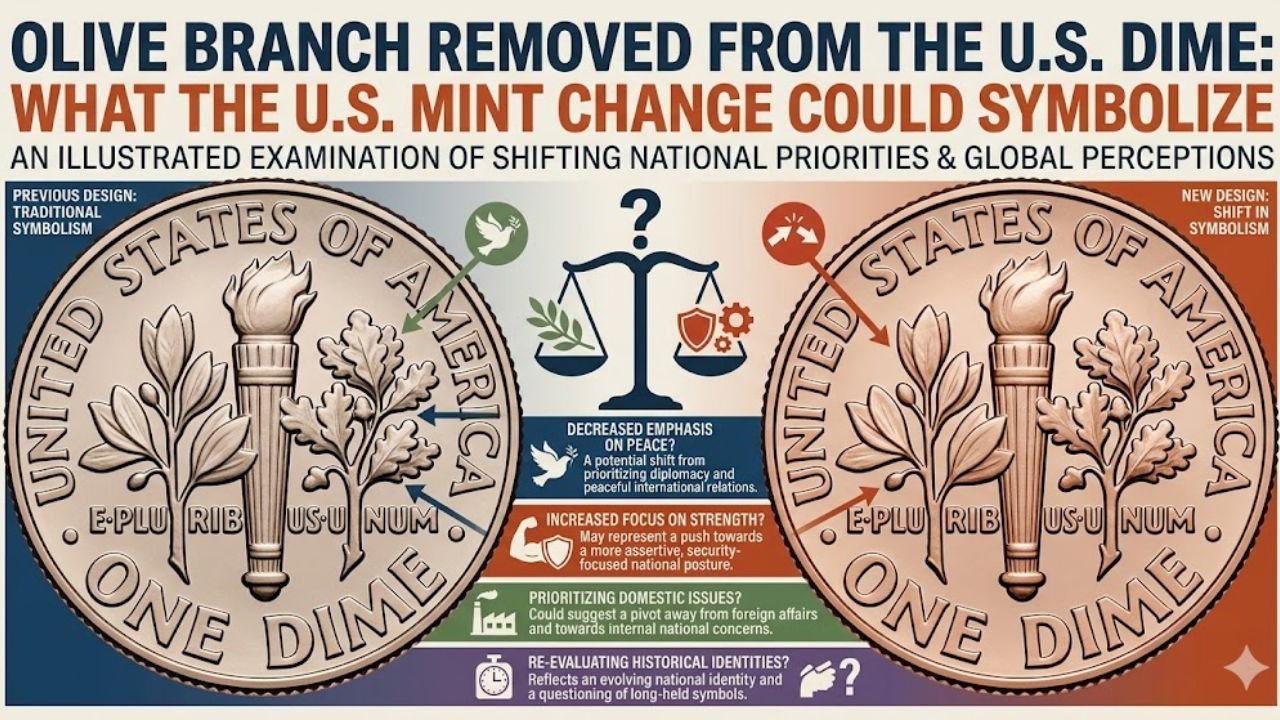
When the U.S. Mint revealed the 2026 dime commemorating 250 years of America’s history, one detail immediately stood out. The olive branch, a long-standing symbol of peace on the Roosevelt dime, is missing.
Instead, the new design features a bald eagle holding arrows and the phrase “Liberty over Tyranny.” The imagery reflects the spirit of the American Revolution and the struggle for independence. However, the absence of the olive branch has sparked discussion about how national symbols communicate values, especially during a time of global conflict and political tension.
How U.S. Coin Symbols Traditionally Balance Power and Peace
For decades, U.S. coins have reflected a balance between strength and restraint. The Roosevelt dime, first introduced in 1946, includes three key symbols on the reverse: a torch representing liberty, an olive branch representing peace, and an oak branch representing strength.
Together, these symbols tell a story about how power should be used. Strength and freedom are important, but they are balanced by diplomacy and peace. Every Roosevelt dime reinforced this message in everyday life, circulating through the hands of millions of Americans.
Why the Olive Branch Has Long Been Important
The olive branch has served as a symbol of peace in Western culture for centuries. It appears in ancient Greek traditions and later became an important emblem in American symbolism, including the Great Seal of the United States.
Historically, the olive branch communicated the idea that the United States preferred diplomacy over war whenever possible. Even during times of conflict, national imagery often included peaceful symbols to represent restraint and balance.
On the Roosevelt dime, the olive branch stood beside the torch of liberty and the oak branch of strength. Together, these elements represented a national ideal that power should be exercised responsibly and guided by peaceful values.
The 2026 Semiquincentennial Dime Design
The 2026 dime is part of the Semiquincentennial Circulating Coin Program, which celebrates 250 years since the United States declared independence in 1776.
For this one-year commemorative design, the traditional portrait of Franklin D. Roosevelt will temporarily be replaced with imagery focused on Revolutionary-era themes. The new reverse design shows a bald eagle with arrows and the inscription “Liberty over Tyranny.”
According to the U.S. Mint, the goal is to allow Americans to “hold 250 years of history in the palms of their hands.” After 2026, the Roosevelt design with its familiar symbols is expected to return.
Symbolism in U.S. Dime Designs Over Time
| Dime Design (Era) | Key Symbols | Core Message |
|---|---|---|
| Roosevelt Dime (1946–2025) | Torch, olive branch, oak branch | Liberty balanced with peace and strength |
| 2026 Semiquincentennial Dime | Eagle in flight, arrows, “Liberty over Tyranny” | Revolutionary struggle and defense of freedom |
| Post-2026 Dime | Return of Roosevelt reverse | Restoration of the traditional symbolism |
Why the Design Change Is Being Interpreted in Different Ways
While the Mint describes the design as a tribute to the Revolutionary War, symbols are rarely neutral. Some observers interpret the emphasis on arrows and the absence of the olive branch as reflecting a more security-focused worldview.
In an era defined by geopolitical rivalry, cyber conflict, and rising defense spending debates, people may view national imagery through the lens of current global tensions.
Others see the design differently. Instead of suggesting aggression, the eagle and arrows may simply honor the sacrifices made by early Americans during the fight for independence.
From this perspective, the phrase “Liberty over Tyranny” celebrates the founding struggle rather than promoting modern conflict. The absence of the olive branch represents the moment before peace was achieved.
A Temporary Design Change
Many collectors and historians emphasize that the change is temporary. The U.S. Mint has stated that the Roosevelt dime will return after the anniversary year.
This highlights how quickly people become attached to national symbols. When familiar imagery changes, even for a limited time, it can trigger strong reactions because these symbols represent stability and shared national values.
Reading National Symbols Thoughtfully
The removal of the olive branch from the 2026 dime is ultimately part of a commemorative program. Coins serve not only as currency but also as small pieces of national storytelling.
Debating their symbols is part of civic engagement. It encourages people to reflect on history, national identity, and the values a country chooses to emphasize.
While a single coin design cannot define a nation’s policies or priorities, it can spark meaningful conversations about how history and symbolism shape public perception.
FAQs
Q1 Will the olive branch disappear from the dime permanently?
No. The U.S. Mint has confirmed that the traditional Roosevelt dime design, including the olive branch, will return after the 2026 commemorative coin program.
Q2 Does the new dime symbolize war?
The Mint states that the imagery reflects the Revolutionary War and the fight for independence. However, some observers interpret the absence of the olive branch as emphasizing strength over diplomacy.
Q3 Will other coins change in 2026?
Yes. Several U.S. coin denominations will feature special designs in 2026 to celebrate the nation’s 250th anniversary.